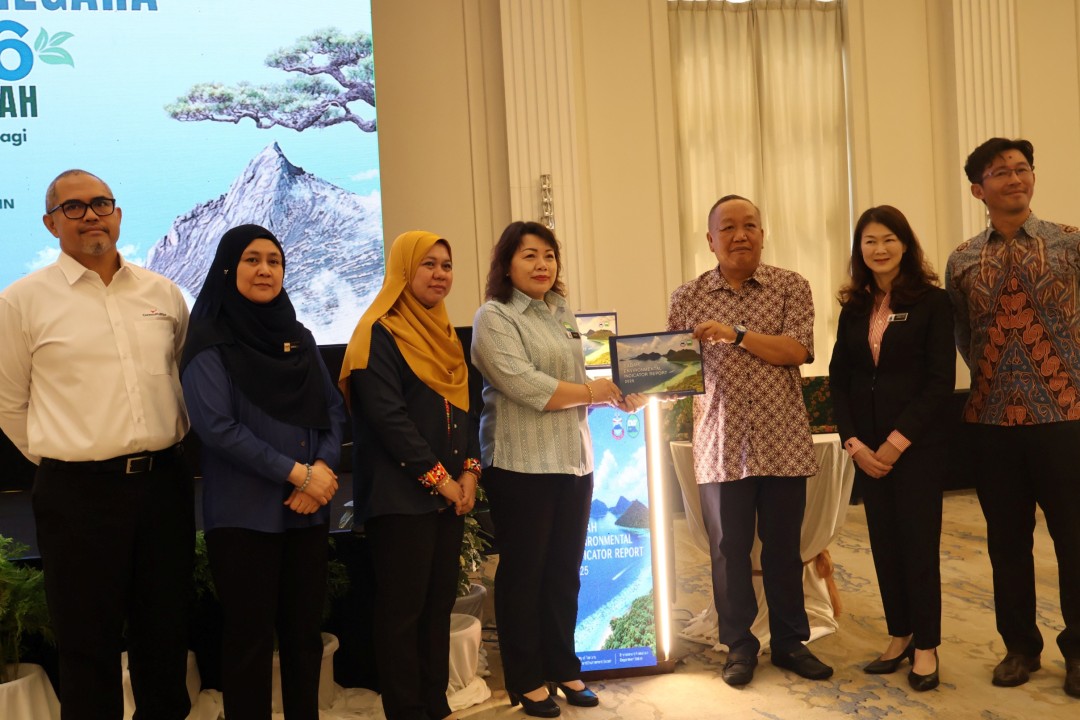
KOTA KINABALU 05 November 2026 (Borneo Post Online): Sabah has launched its 2025 Environmental Indicator Report to provide a comprehensive, data-based overview of the state’s environmental conditions and strengthen environmental monitoring, planning and decision-making.
Tourism, Culture and Environment Minister Datuk Jafry Ariffin said the report focused on five key areas ― land use, air quality, water quality, biodiversity and social dimensions, while highlighting environmental trends, challenges and possible solutions based on established standards.
“Environmental protection is a commitment of the Sabah government in ensuring that environmental sustainability and socio-economic development are pursued in a balanced manner,” he said.
Jafry was speaking at the state-level National Environment Day (HASN) 2026 celebration at The Palace Hotel here on Thursday, where he officially launched the report.
He said the latest edition was produced under a study conducted through the 12th Malaysia Plan (12MP), focusing on the implementation of the Sabah Environmental Policy Action Plan and the Environmental Quality Monitoring Master Plan.
The first Sabah Environmental Indicator Report was published in 2003.
However, Jafry acknowledged that despite efforts to ensure comprehensive information was included, the preparation of the latest report had encountered several limitations due to insufficient or unavailable data.
He emphasised the need for systematic environmental data development and stronger coordination among government agencies to support more comprehensive and effective environmental planning and monitoring.
“These challenges clearly demonstrate the need to develop environmental data in a more systematic manner and strengthen data coordination between agencies,” he said.
Jafry said two key agencies played essential roles in safeguarding Sabah’s environment, namely the Environment Protection Department (JPAS) and the Sabah Department of Environment (JAS).
JPAS, which comes under his ministry, enforces the Environment Protection Enactment 2002 and ensures environmental considerations are incorporated into development planning, implementation and control, as well as the sustainable use of natural resources.
It also addresses pollution through strategic approaches and coordinates environmental education initiatives through theSabah Environmental Education Network (Seen), which comprises 44 organisations from the government, private sector, NGOs and higher learning institutions.
Meanwhile, JAS enforces the Environmental Quality Act 1974 and monitors environmental quality through air, river, marine and groundwater monitoring programmes, alongside public awareness initiatives on pollution prevention, waste management and environmental conservation.
At the same event, Jafry highlighted Sabah’s achievement in the national Sustainable School – Environmental Award Scheme (SLAAS) 2025/2026, following SMK Holy Trinity, Tawau, winning the national award under the secondary school category on Sept 21 in Melaka.
Introduced in 2005, SLAAS is a collaborative initiative involving the Department of Environment Malaysia, the Education Ministry and the Institute for Environment and Development (Lestari) of Universiti Kebangsaan Malaysia.
It encourages schools to integrate environmental conservation into their management, curriculum, co-curricular activities and school surroundings.
The celebration also saw the presentation of a RM100,000 sponsorship cheque from PTT Exploration and Production Public Company Limited (PTTEP) for the 2026/2027 session of the School Environmental Partner Programme (Serasi).
Jafry expressed appreciation to PTTEP for its continued support of SERASI since 2023, noting that the partnership would help more schools implement practical and sustainable environmental education initiatives.
Launched in 2003, SERASI is Sabah’s flagship environmental education programme, jointly organised by JPAS and JAS to recognise schools’ efforts in promoting environmental awareness and conservation within their institutions and surrounding communities.
At the state-level SLAAS 2025/2026 awards presentation, SMK Holy Trinity, Tawau, emerged as the champion in the secondary school category, receiving RM3,000, followed by SMK Taman Tun Fuad, Kota Kinabalu, with RM2,000, and SMK Datuk Peter Mojuntin, Penampang, in third place with RM1,500.
In the primary school category, SJKC Tai Tong, Sandakan, took first place with RM3,000, followed by SJKC Cheng Ming, Keningau, with RM2,000, and SK Lok Yuk, Inanam, with RM1,500.
Five other primary schools received consolation awards of RM1,000 each.
They were SJKC Chi Hwa, Sandakan (fourth place); SK Buang Sayang, Papar (fifth); SK Kampung Simunul, Semporna; SK Kauluan, Tuaran; and SJKC Chi Vun Entabuan, Tenom.
All the winning schools received their respective cash prizes and certificates of achievement during the awards presentation held in conjunction with the National Environment Day celebration today.
Jafry also thanked the government agencies, NGOs, private sector representatives, teachers and students for their continued commitment to environmental protection.
He acknowledged the contributions of JPAS and JAS as the main organisers, as well as strategic partners ConocoPhillips Sabah Gas Ltd, Global Peace Foundation Malaysia and PTTEP in making the celebration a success.
Source: https://www.theborneopost.com/2026/11/05/sabah-launches-environmental-report-to-strengthen-monitoring-guide-development-planning/